With the demand for skilled workers continuing to rise coupled with the lingering educational effects of a global pandemic, it is no longer enough to start planning for career aspirations during a student’s junior—or even freshman—year of high school. Students who have a longer career exploration runway are better positioned to make the right decisions along their education journey to put them on a path to life-long economic success and personal fulfillment. Starting career exploration in middle school is now a necessity.
“I feel like there aren’t enough [opportunities to learn about careers in school]. I feel like we need more time to do it. Because it’s once a year and you get a five-day unit about what you want to do. Okay, that’s nice. Goodbye. We’re moving on." — student interview with Lexi, 8th grade student in Virginia
A National Analysis of Middle School Career Exploration
Through an in-depth national scan of all 50 states and Washington, D.C., including student and expert interviews, against 13 criteria across 3 categories, Britebound (formerly American Student Assistance) and Education Strategy Group (ESG) set out to understand states’ current approaches to defining, investing in, and supporting the implementation of middle school career exploration and perhaps more importantly, how current students are experiencing these efforts.
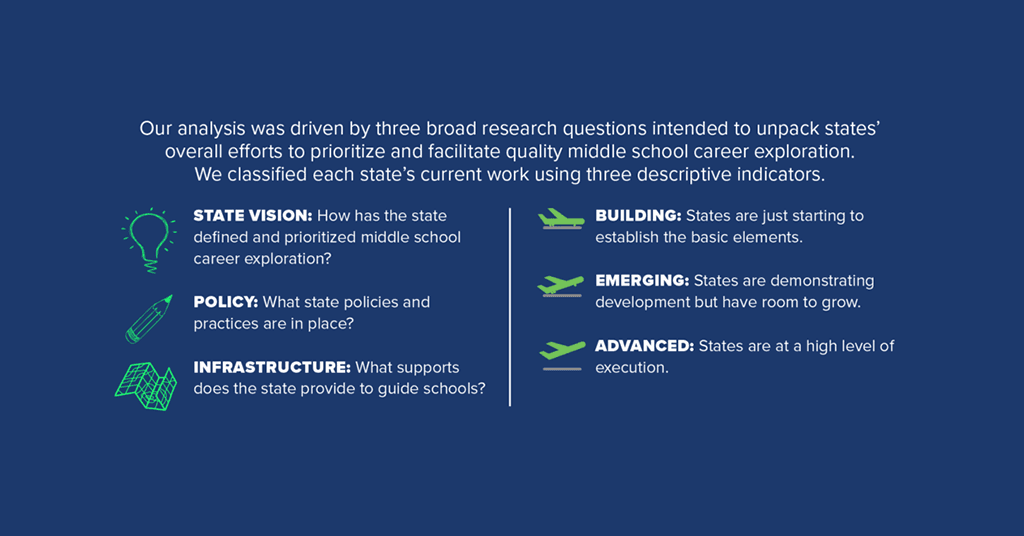
Our analysis was driven by three broad research questions:
- State vision: How has the state defined and prioritized career exploration for middle school students?
- Policy: What policies and practices have states put into place to enable student access to meaningful career exploration experiences?
- Infrastructure: What supports have states put in place to help schools provide meaningful career exploration experiences for middle grades students?
We classified each state's current work using three descriptive indicators:
- Building: States are just starting to establish the basic elements.
- Emerging: States are demonstrating development but have room to grow.
- Advanced: States are at a high level of execution.
Key Findings
Overall, our research found that states have a strong start in this relatively new space, but without a unified state vision and commitment, a prioritization of students’ need for more relevant, diverse and hands-on experiences in a continuum throughout K-12, and sustained financial support and local capacity building, they risk making career exploration a series of paper-pencil activities that miss the opportunity to help shape students’ path to a fulfilling career that pays a living wage.
Students want more than they’re getting:
- They want hands-on experiences, like job shadowing and workplace visits, rather than presentations.
- They learn more about careers from family than from school.
- The activities they do complete, like career interest inventories, feel disconnected from real long-term planning.
Most states have the basics in place:
- 92 percent dedicate funding to support career exploration activities: For many states, that money comes only from federal sources, mainly Perkins V, the federal law that funds career and technical education.
- 92 percent have some form of requirement in policy: In 27 states, that includes having students start an individual career and academic plan in middle school.
Few states measure the quality of that work:
- 20 percent collect data on it: Without that data, most states can’t tell whether students are getting the experiences their policies require.
- 16 percent include it in accountability plans: Only Pennsylvania and Georgia count it toward their federal school ratings.
Five Priorities for States
The report highlights five practices for state leaders working to improve students' readiness:
- Creating a clear and coordinated vision for middle school career exploration
- Supplementing state policies with hands-on activities and other resources
- Investing in the capacity to support quality implementation
- Braiding funding to drive scale and innovation
- Utilizing data collection and accountability systems to ensure programmatic quality
Read the full report or watch our webinar for examples of best practices in state vision, policies, funding, implementation, data collection and accountability. The report also includes ratings for every state, state spotlights, and recommended actions for state and local leaders.
For a closer look at the findings, read why middle school career exploration matters.
To put these findings into practice, explore Britebound's digital experiences, which help students discover their interests and help educators bring career exploration into the classroom.