
A new study uncovers evolving trends in teenagers’ attitudes, perceptions, and decision-making about their postsecondary plans.
At Britebound™ (formerly American Student Assistance), we’re committed to understanding the shifting landscape of education and career exploration for today’s teens. Our latest national survey of over 3,000 teens, conducted in December 2024, offers key insights into how young people are thinking about their futures — and the results reveal a promising evolution in post-high school planning.
The Decline in College Intentions
A decade ago, attending college was widely considered the default path after high school. But today, that assumption no longer holds true. Our data shows that:
- Only 45% of teens consider college (2-year or 4-year) their most likely next step — down from 73% in 2018 and 50% in 2021.
- Meanwhile, interest in diverse education pathways — such as apprenticeships, vocational schools, and certification programs — has surged, growing from 12% in 2018 to 38% in 2024.
This shift highlights a growing awareness among teens that success doesn’t always require a degree — and that hands-on, skills-based training can be a direct route to a stable and fulfilling career.
Parental Influence: A Key Factor in Decision-Making
Parents play a crucial role in shaping their children’s post-high school decisions. Our research found that:
- More than 90% of teens have discussed their future plans with a parent.
- However, parental agreement is stronger for those pursuing college (82% of parents agree with their teen’s plan) than for those considering nondegree paths (66%).
This suggests that while teens are exploring diverse educational options, they may still need support in helping their families understand and validate those choices.
Who’s More Likely to Choose College?
Our research also reveals significant demographic differences in college intentions:
- Girls are more likely than boys to plan for college (53% vs. 39%).
- Teens of color show a higher likelihood of choosing college, with 54% of Black and 51% of Latino/a teens considering it, compared to 42% of white teens.
- Suburban teens (64%) are significantly more college-focused than their rural (46%) and urban (39%) peers.
These insights raise important questions about access, opportunity, and the unique challenges faced by different student populations.
What Teens Are Saying About Their Choices
Beyond the data, we’re gaining powerful insights through Project Waypoint, Britebound’s online teen community. Here’s what some teens had to say about their decision to pursue options beyond a four-year college:
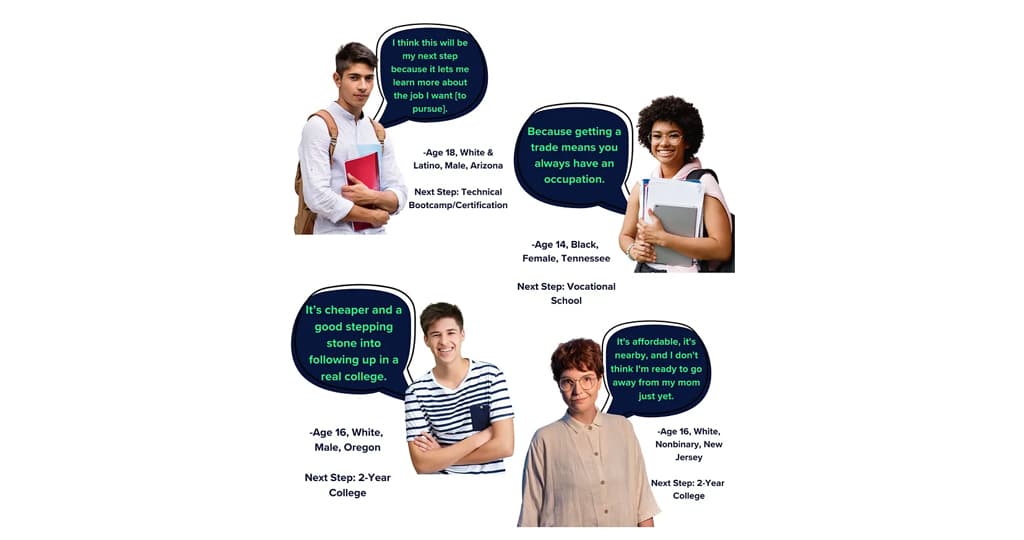
These voices reflect the diverse considerations teens are weighing — cost, career preparation, stability, and personal readiness.
What This Means for the Future of Education-to-Career Pathways
As teens continue to rethink traditional education paths, it’s essential for educators, parents, business leaders, youth-serving organizations, and policymakers to recognize and support multiple routes to success. Whether through college, career training, apprenticeships, or other credentialing programs, today’s students are making more intentional, informed choices than ever before.